
Product Showdown: A500 vs A513
At a Glance: ASTM A500 Hollow Structural Sections are manufactured for load-bearing applications and backed by a Mill Test Report (MTR) verifying yield strength, tensile strength, and elongation. ASTM A513 is mechanical tubing built for dimensional precision, with no physical property reporting required. Specify A500 for any structural framing, columns, or connections; use A513 only where fit precision, not load-bearing capacity, drives the selection.
A common question that arises during the material specification process is the functional difference between ASTM A500 and ASTM A513 steel tubing. Customers and design teams sometimes assume these specifications are interchangeable. However, when we delve deeper into the material properties and manufacturing standards, multiple differences emerge.
As a structural engineer, your mandate is to create efficient, constructible designs that meet structural integrity requirements while managing cost constraints. Specifying the wrong tubing can lead to compromised load-bearing capacities, budget overruns, or delayed project timelines.
This guide breaks down the core differences between A500 and A513 tubing, outlines their distinct applications, and provides the technical context you need to optimize material selection for your projects.
What is A500 Tubing?
ASTM A500 tubing goes by several names in the industry. Engineers most commonly refer to it as Hollow Structural Sections (HSS), although structural tubing and tube steel (TS) are sometimes used.
Manufacturers produce A500 tubing specifically for structural load-bearing applications. Due to its high strength-to-weight ratio and efficient characteristics, A500 HSS frequently serves as the structural backbone for large commercial and industrial projects like factories, stadiums, warehouses and data centers. It can be used as structural framing for server racks, cooling towers, MEP skids, architecturally exposed canopies and much more.
When you order A500 tubing from a mill, each bundle will have a Mill Test Report (MTR) available. The MTR details the chemical composition of the steel coil used to manufacture the tube and verifies the physical properties, including yield strength, tensile strength, and elongation. This documented proof of physical capability is an important distinction between A500 and A513 material.
Atlas Tube offers a full size range of domestic ASTM A500 HSS. This includes Jumbo HSS™, with sizes reaching up to 22-inch square, 28-inch round, and 34×10 inch rectangle, all with wall thicknesses up to 1 inch. In addition to MTRs, Atlas also offers factory-specific EPDs to help engineers precisely calculate GWP and optimize LEED credits when working with HSS. With full material traceability and the shortest lead times in the industry, our HSS allows engineers to push the boundaries of structural design while maintaining efficient supply chains and delivering projects on compressed timelines.
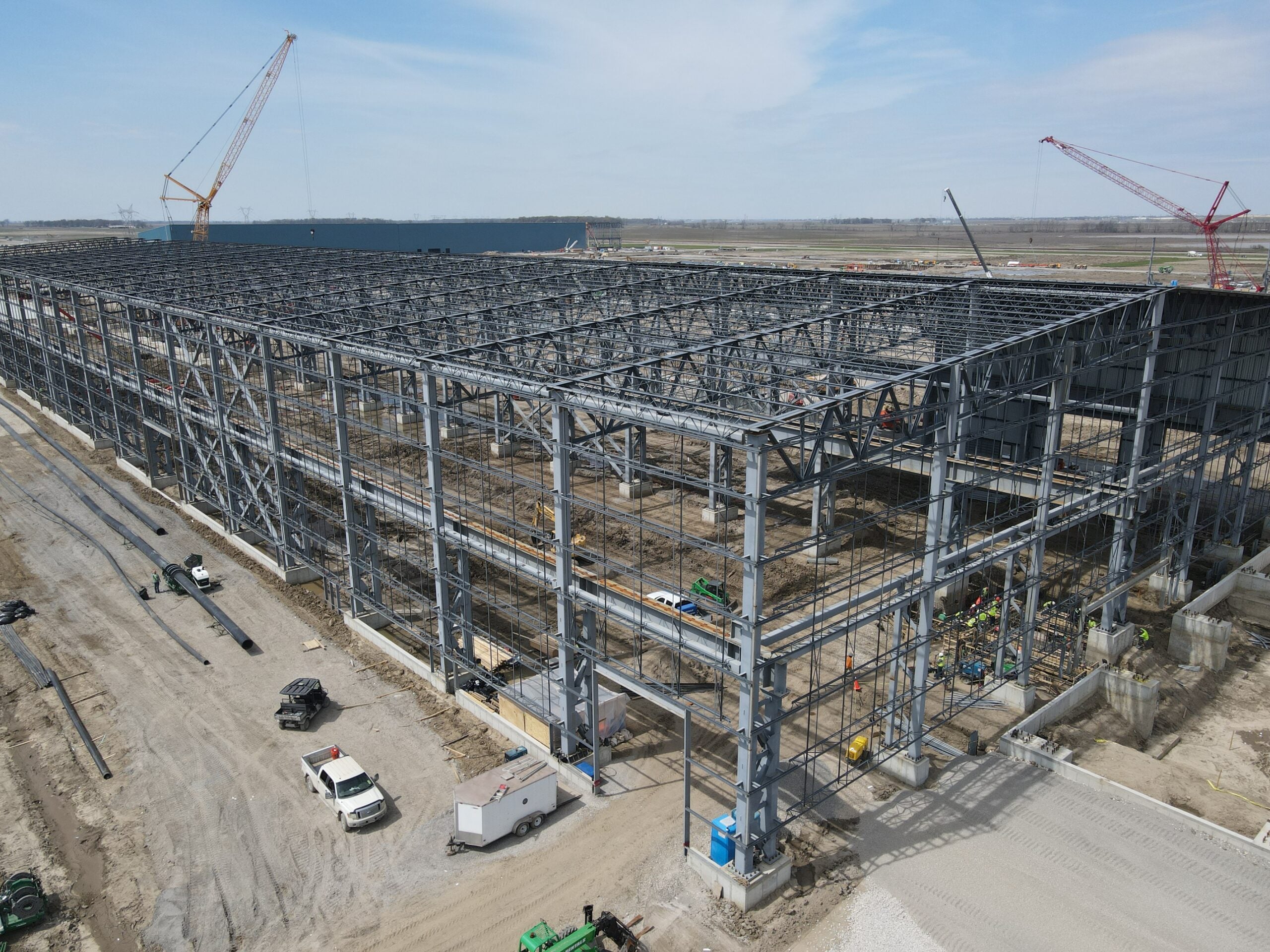
ASTM A500 Jumbo HSS enables teams to increase efficiency on large projects.
What is A513 Tubing?
A513 is classified as mechanical tubing. Manufacturers produce this material for applications where tight dimensional tolerances are necessary, but load-bearing capacity is not a primary concern.
A513 tubing does not support structural loads, and so the manufacturing standard does not require the reporting of yield, tensile, or elongation properties. Instead, material reporting focuses on dimensional accuracy and surface finish.
You will typically find A513 tubing in products like lawnmower handles, recreational vehicle components, furniture frames, and machinery enclosures. A513 may also be used in shelving units, sporting equipment, and other areas where weldability and precise dimensional tolerances are required. While it excels in these mechanical applications, A513 lacks the verified structural properties required for building infrastructure frameworks.
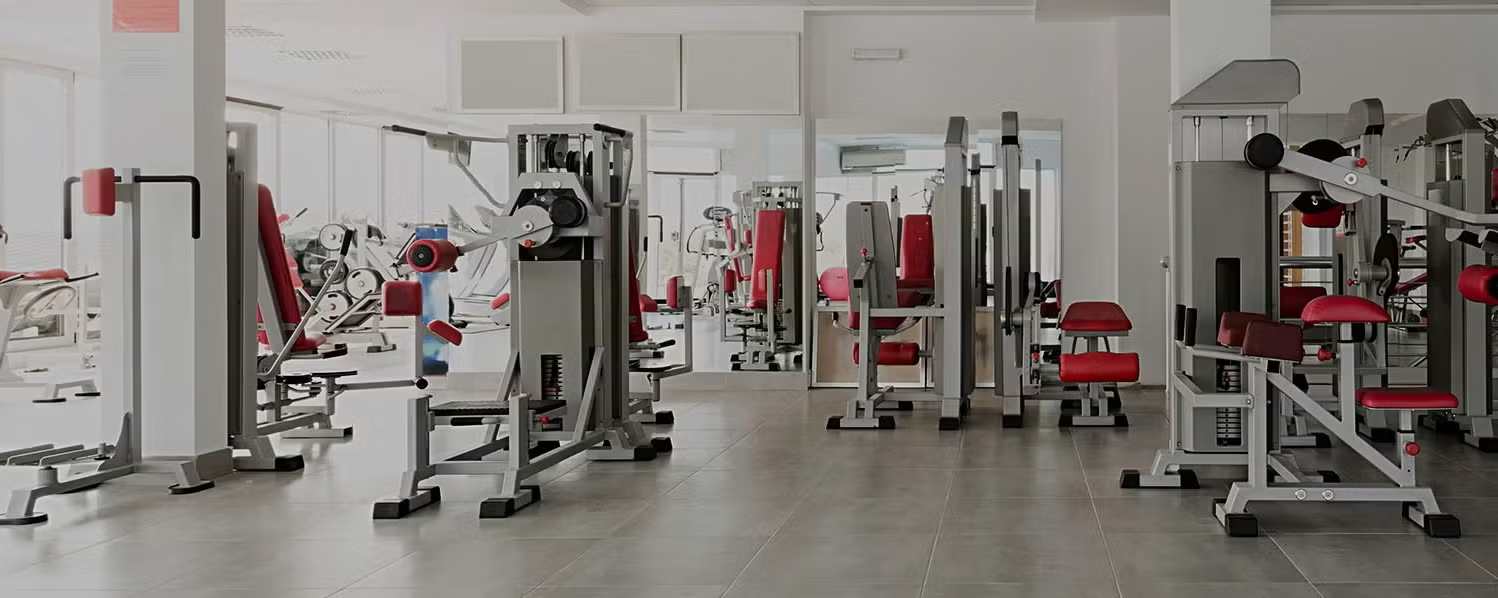
ASTM A513 mechanical tubing has the tight tolerances required for equipment like weightlifting machines.
Key Differences Between A500 and A513
When specifying material for your next project, understanding the precise differences between these two specifications ensures structural reliability and code compliance.
- Physical and Structural Requirements
A500 mandates rigorous testing and reporting of physical properties. Structural engineers rely on these documented yield and tensile strengths to perform accurate load calculations. A513 carries no such requirements. Using A513 in a structural capacity introduces significant risk and is not recommended, as the material lacks documented load-bearing capabilities.
- Dimensional Tolerances
A513 mechanical tubing offers tighter dimensional tolerances compared to A500. Because A513 serves in mechanical assemblies where parts must fit together precisely, the manufacturing process restricts variations in outer dimensions and corner radii.
For example, on a 2×2-0.083 tube:
A513: The corner radius ranges tightly from 5/64 inches to 1/8 inches.
A500: The maximum corner radius is 0.249 inches, allowing greater corner radius variability while maintaining structural mass.
- Stenciling and Identification
Tracking materials on a busy job site requires clear identification. For A500 tubing, industry standards require stenciling for any tube with a side measuring 5 inches or larger. This stenciling helps fabricators and contractors verify they are using the correct structural grade material for specific connections and load-bearing columns. A513 material requires no such stenciling.
A500 vs. A513 Specification Comparison Table
| Feature | ASTM A500 (Structural / HSS) | ASTM A513 (Mechanical) |
|---|---|---|
| Primary Application | Load-bearing structures, buildings, bridges, data centers | Consumer products, machinery parts, furniture, shelving racks |
| Dimensional Tolerances | Looser (e.g., 2×2–0.083 max corner radius is 0.249“) | Tighter (e.g., 2x2x0.083 corner radius is 5/64″ to 0.125″) |
| Physical Requirements | Strict verification of yield, tensile strength, and elongation | No physical requirements or structural verification |
| Documentation | Material Test Report (MTR) provided | No MTR provided |
Moving Foward With Confidence
Understanding the difference between structural and mechanical tubing protects your project from specification errors and engineering failures. Always specify ASTM A500 for any application requiring load-bearing capabilities. Leverage the documented MTRs and factory-specific EPDs from a domestic manufacturer like Atlas to ensure code compliance and create efficient, cost-effective structures.
By capitalizing on the largest domestic range of HSS sizes and utilizing new connection technology from Atlas Tube like the HSS Connections Hub™ or the Shuriken Structural Nut Keeper®, you can navigate design changes swiftly and deliver highly functional spaces that meet all stakeholder expectations.
For additional technical support, connection design resources, or general HSS assistance, contact a sales representative or one of our HSS experts.
Frequently Asked Questions
What is the difference between ASTM A500 and ASTM A513 steel tubing?
ASTM A500 is a structural specification for Hollow Structural Sections (HSS) that requires documented yield strength, tensile strength, and elongation through a Mill Test Report (MTR); ASTM A513 is a mechanical tubing specification focused on dimensional precision with no requirement to verify or report physical properties. The two specifications serve fundamentally different purposes and are not interchangeable.
Can ASTM A513 tubing be used in structural applications?
No. Because A513 does not require testing or reporting of yield strength, tensile strength, or elongation, there is no documented basis for load calculations or code compliance — ASTM A500 is the correct specification for any load-bearing application.
What are the dimensional tolerance differences between A500 and A513 tubing?
ASTM A513 holds tighter dimensional tolerances than ASTM A500 — on a 2×2–0.083 tube, A513 restricts the corner radius to 5/64–1/8 inch while A500 permits a maximum of 0.249 inches. A500’s looser tolerances are structurally sufficient because its performance is defined by verified material properties, not exact dimensional geometry.
What documentation comes with ASTM A500 HSS, and why does it matter?
Every bundle of ASTM A500 HSS ships with a Mill Test Report (MTR) that verifies the chemical composition and physical properties — yield strength, tensile strength, and elongation — of the specific heat used to produce it. A513 carries no equivalent report, which is why it cannot be substituted in structural applications requiring traceability.
How do I distinguish A500 from A513 tubing on a job site?
ASTM A500 requires stenciling on any tube with a side measuring five inches or larger; A513 has no stenciling requirement. For tubes smaller than five inches, confirm the specification through the bundle’s MTR or purchase documentation before incorporating material into a structural application.
Brad Fletcher, Senior Structural Engineer at Atlas Tube, holds the S.E. license—structural engineering’s most advanced credential. With 30+ years of practice, he has served as an HSS industry liaison since 2011.