
4 Free HSS Engineering Tools for Faster Structural Design
At a Glance: Atlas Tube offers four 100% complimentary HSS engineering tools — the HSS Connections Hub™, the Wide Flange vs. HSS Beam Comparison Tool, the HSS vs. Wide Flange Column Comparison Tool, and the Axial Load Calculator— designed to accelerate connection design, material selection, and column capacity evaluation for structural engineers.
Structural engineering continues to demand more optimization, efficiency, and cost-effective material selection than ever before. Navigating design changes, managing stakeholder expectations, and working within compressed timelines requires reliable data and streamlined workflows. The inherent efficiencies of hollow structural sections (HSS) can help engineers meet those project requirements, but only when the right design tools back them up. Atlas Tube’s complimentary tools are built to close the gap between HSS’s theoretical advantages and real-world project execution.
What Is the HSS Connections Hub™ and How Does It Simplify Connection Design?
The HSS Connections Hub™ is a first-of-its-kind HSS design tool suite created by engineers, for engineers. Designing HSS connections has long been perceived as a challenge — one that frequently requires custom spreadsheets, repetitive limit state checks, and multiple design revisions before fabricators can move forward.
The HSS Connections Hub eliminates that friction by centralizing connection calculators, downloadable typical details, and expert support in a single, complimentary platform.
The HSS Connections Hub covers all major connection categories, including:
- WF beam to HSS column shear connections
- WF beam to HSS column moment connections
- HSS to HSS shear connections
- HSS to HSS moment connections
- HSS to WF shear and moment connections
- HSS splice connections
- HSS truss connections (T, K, Y, X, and KT types)
- Chevron bracing and column bracing connections
- HSS steel base plate connections
- Concrete-filled HSS moment connections
- HSS to HSS splice gusset connections
- CastConnex Bracing connections
All calculators are available for both AISC (USA) and CISC (Canada) design standards, and each calculation step is referenced to the relevant formula and code check — which means exports go directly into project submittals without additional reformatting.
What Connection Detail Formats Does the HSS Connections Hub Provide?
Creating HSS connection details from scratch consumes valuable engineering hours and often produces redesign requests from connection detailers and fabricators, delaying schedules and increasing costs. The HSS Connections Hub addresses this with a growing library of over 150 Typical HSS Connection Details, covering the same categories as the connection calculators:
- WF beam to HSS column shear connections
- WF beam to HSS column moment connections
- HSS to HSS shear connections
- HSS to HSS moment connections
- HSS to WF shear and moment connections
- HSS splice connections
- HSS truss connections (T, K, Y, X, and KT types)
- Chevron bracing and column bracing connections
- HSS steel base plate connections
- Concrete-filled HSS moment connections
- HSS to HSS splice gusset connections
- CastConnex Bracing connections
All HSS Typical Details are available for download in three formats:
- PDF — for immediate review and inclusion in project packages
- AutoCAD (.DWG) — for direct integration into existing CAD libraries
- Revit (.RVT) — for BIM workflows
Using standardized, constructible HSS connection details reduces RFIs, minimizes material waste, and accelerates project timelines. The detail library continues to grow as the Atlas Tube team adds new connection types.
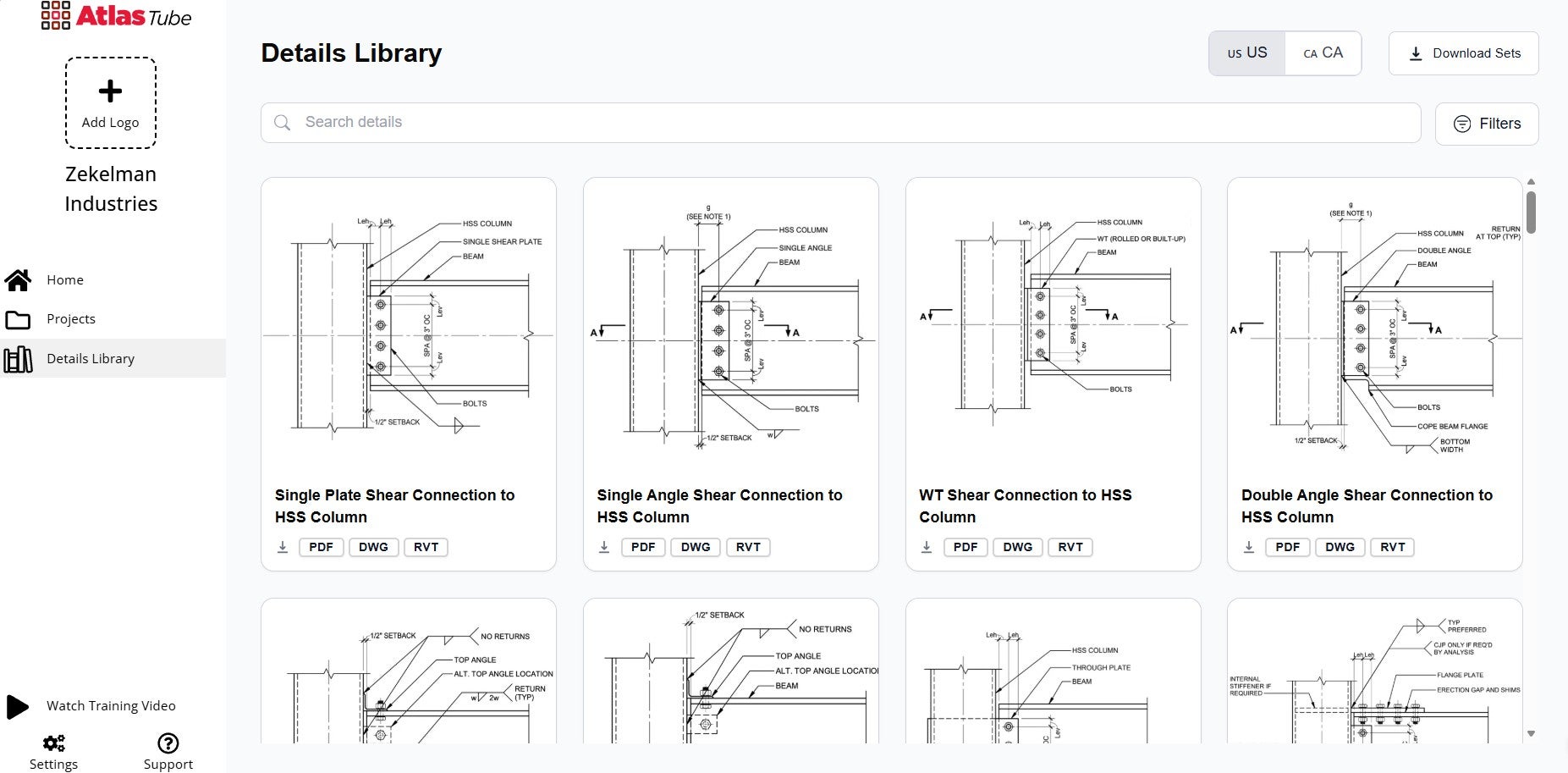
The Hub’s Typical Details Library helps improve design efficiency.
How Do the HSS Connection Calculators Replace Custom Spreadsheets?
The HSS Connections Hub replaces outdated, highly customized spreadsheets with more than 80 real-time HSS Connection Calculators for AISC and CISC standards. The problem with project-specific spreadsheets is straightforward: they carry project-specific assumptions that produce incorrect results or require significant re-engineering when reused on future projects with different requirements. That creates maintenance overhead, error exposure, and fabrication cost risk.
The HSS Connections Hub calculators address each of those failure modes:
- Live calculations and utilization checks — inputs update results in real time, so you see the effect of section changes immediately
- Alignment with the AISC Steel Construction Manual (16th Edition, 2023) — every check references the relevant code equation and section
- Alignment with CISC S16:19 – Design of Steel Structures — every check references the relevant code equation and section
- Support for HSS moment connections and shear connections — across both square, rectangular and round HSS
- Exportable calculation reports — each report clearly shows every step of the calculation for submittal to the EOR, project team, or AHJ
The result is faster approvals, fewer back-and-forth cycles with fabricators, and a calculation record that holds up under peer review. Each calculator is developed and maintained regularly, so code updates are reflected in the tool rather than left to individual users to patch into aging spreadsheets.
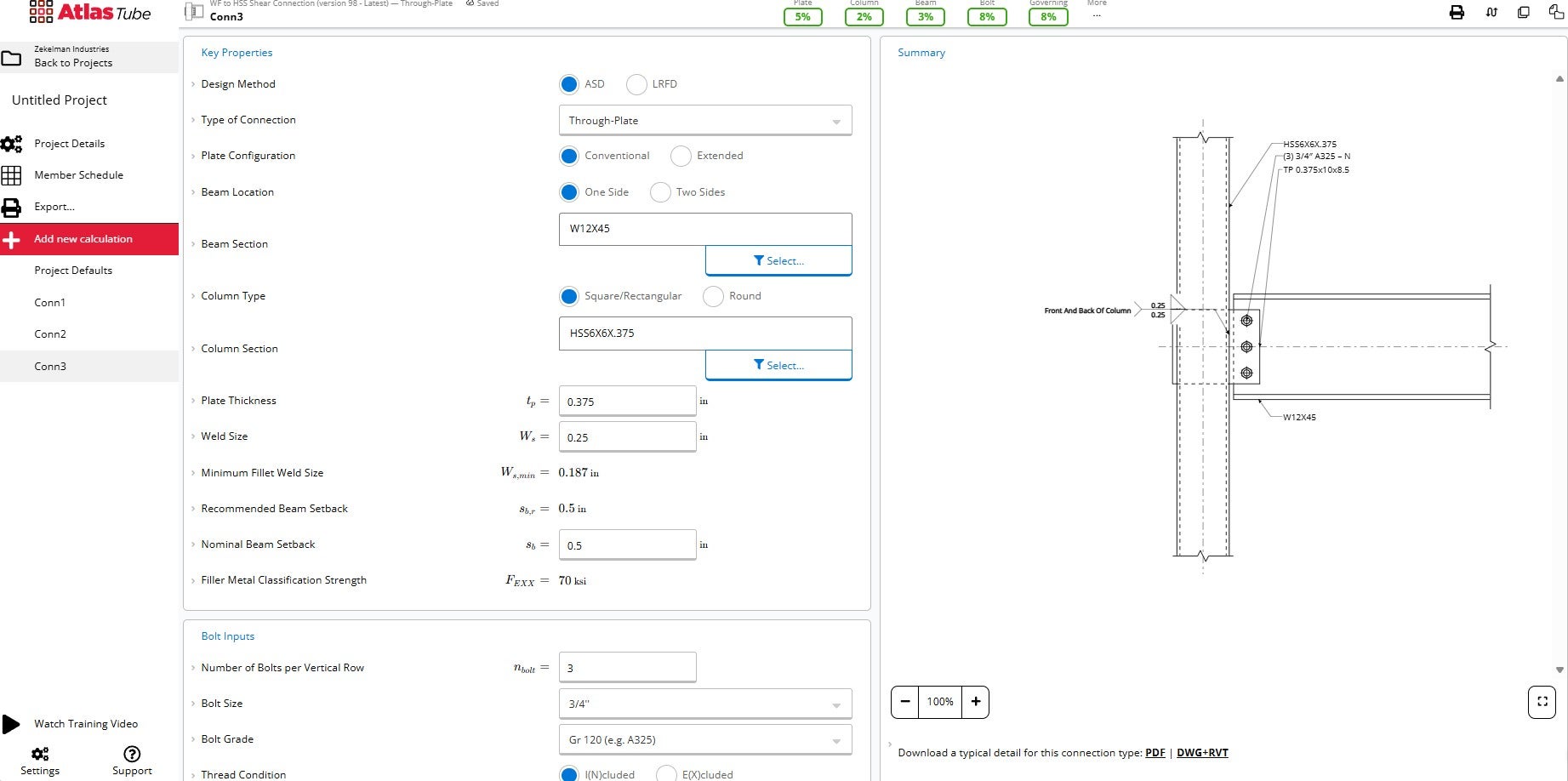
The Hub’s comprehensive Connection Calculators help engineers design simple and complex HSS connections.
Where Can Engineers Get Expert Support Through the HSS Connections Hub?
Beyond the calculators and details, the HSS Connections Hub connects you directly with Atlas Tube’s in-house structural engineering experts, who can assist with:
- Complex HSS connection designs that fall outside standard calculator coverage
- Design code interpretation, including limit states specific to HSS
- HSS Connections Hub usage and optimization for specific project conditions
Atlas Tube’s Engineering Experts team has decades of combined experience designing and advising structural engineers on HSS design, product availability, and connection detailing. That direct access matters most at the inflection points in a project when a late design change requires a rapid connection reassessment, or when a fabricator raises a constructability question that standard references can’t fully resolve.
How Does the Wide Flange vs. HSS Beam Comparison Tool Work?
This is the most recent tool created by Atlas Tube to support engineers. Replacing wide flange in beam applications with HSS can improve efficiency in bending applications — particularly where torsional resistance, cleaner structural lines, or architectural exposure are design priorities. The Wide Flange vs. HSS Beam Comparison Tool evaluates HSS alternatives against a selected wide flange section under the following assumptions:
- Simply supported beam with a uniformly distributed factored gravity load
- Flexural capacities calculated per AISC 360-22 Chapter F using the LRFD method
- Top flange bracing conditions selectable from 0% (completely unbraced) to 100% (continuously braced)
- Yield strength selectable to match the specified material (typically ASTM A992, Fy = 50 ksi, for wide flange; ASTM A500 Grade C, Fy = 50 ksi, for HSS)
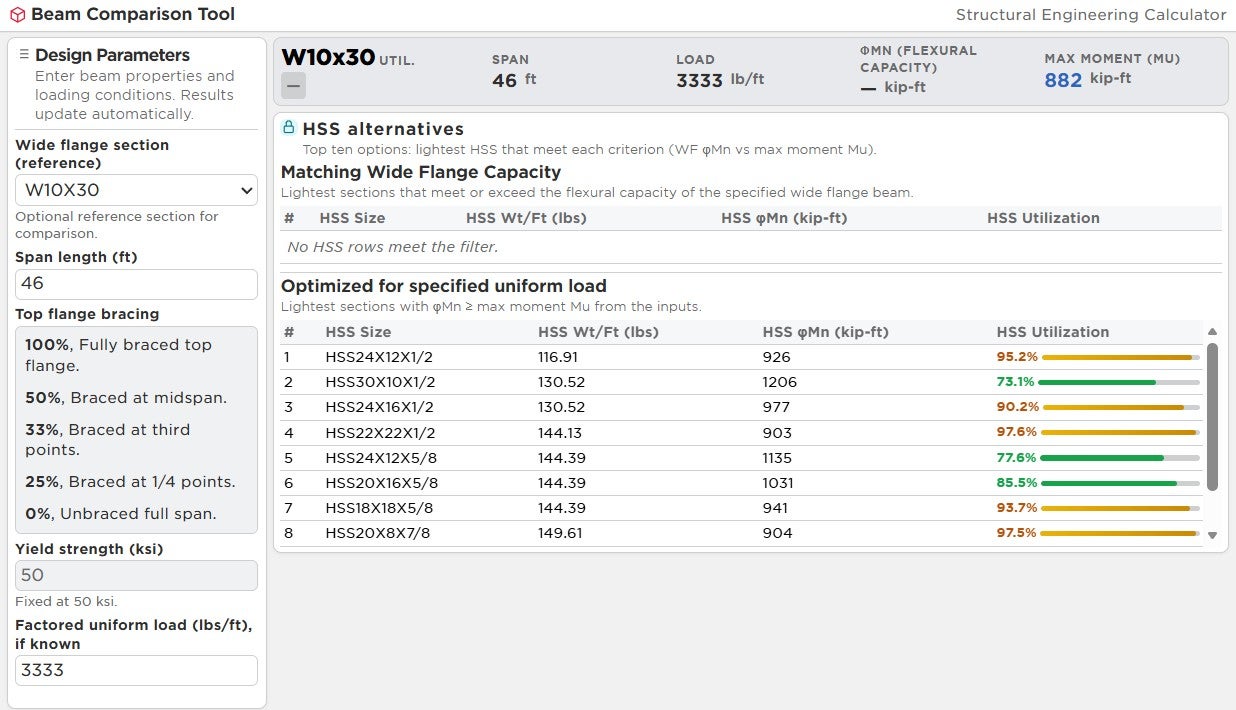
The Wide Flange Vs. HSS Beam Comparison Tool helps engineers design with HSS in environments where torsional resistance and aesthetics are a priority.
Note that the tool does not calculate beam deflection or other serviceability criteria — those checks remain the engineer’s responsibility for final design.
What Are the Two Design Modes in the HSS Beam Comparison Tool?
The Wide Flange vs. HSS Beam Comparison Tool operates in two distinct modes, both returning the top ten lightest HSS sections that meet applicable criteria:
- Matching wide flange capacity — identifies the lightest HSS beam sizes that meet or exceed the flexural capacity of a specified wide flange beam, without reference to a specific load. Use this mode when the controlling design is the wide flange flexural capacity rather than a specific demand.
- Optimized for specified uniform load — takes a factored uniformly distributed gravity load as input and returns the lightest HSS sections whose flexural capacity meets or exceeds the maximum moment demand. Use this mode when you know the load and want to minimize section weight.
For each returned HSS section, the tool displays HSS size designation, weight per foot, flexural capacity (φMn), and utilization ratio. Weight and cost savings calculations are available once a specific HSS section is selected and the number of beam replacements is entered.
When Is an HSS Beam the Right Choice Over a Wide Flange?
Closed-section HSS beams outperform wide flange sections in applications where torsion is a design consideration — a condition that arises more often than many engineers initially account for. Wide flange sections have very low St. Venant torsional stiffness relative to HSS. When eccentric loading or curved geometries introduce torsional demand, an HSS beam section can handle that load with significantly less added material than a wide flange reinforced for torsion. Finally, in cases where the lead time for wide flange isn’t acceptable for the project schedule, HSS is generally more readily available and can be substituted.
Choose HSS for a beam application when:
- Wide flange sections aren’t available
- Torsional loading is a design consideration
- Architectural exposure requires a cleaner section profile
- Reducing overall beam weight is a project objective
- The span is simply supported with a known uniform gravity load
How Does the HSS vs. Wide Flange Column Comparison Tool Work?
When designing gravity columns, material selection directly impacts cost, footprint, and performance. HSS columns offer a high radius of gyration about both axes, delivering excellent compression behavior compared to traditional wide flange shapes. HSS columns can support higher axial loads for the same footprint, which typically means less total tonnage of steel in the structure.
The HSS vs. Wide Flange Column Comparison Tool makes that trade-off quantitative. Engineers enter current wide flange section designations, column length, and quantity. The HSS vs. Wide Flange Column Comparison Tool returns the recommended HSS replacement sections alongside a calculated summary of:
- Weight savings — in pounds or tons, depending on the quantity entered
- Cost savings — based on material weight differences
Results can be emailed as a personalized report — a useful resource for value engineering presentations or when justifying a material switch to project stakeholders.
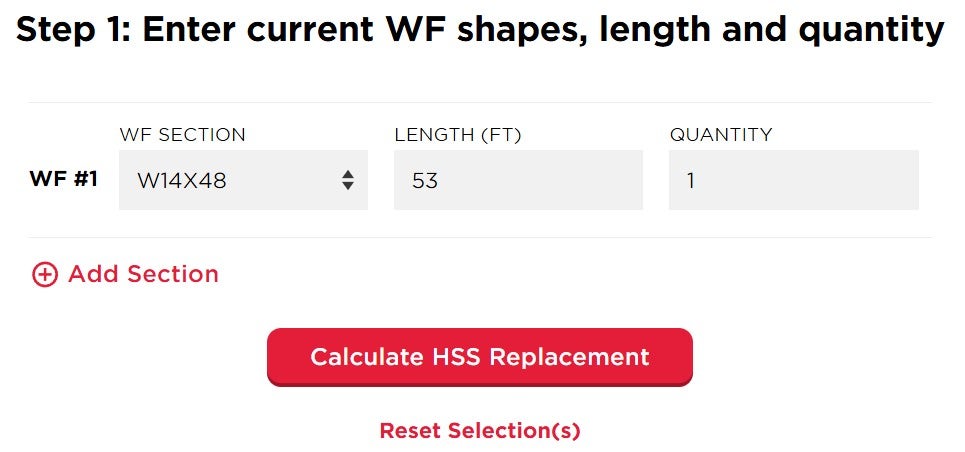
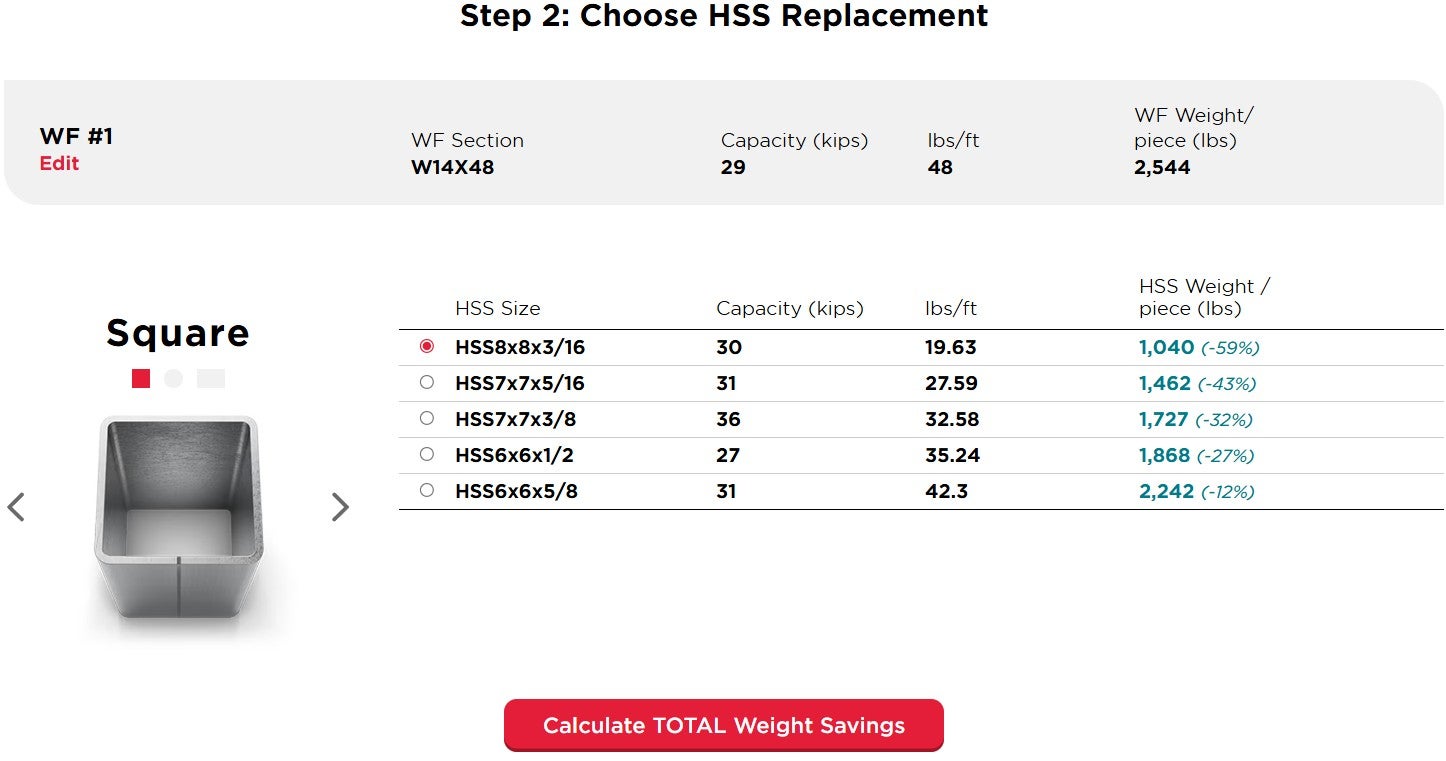
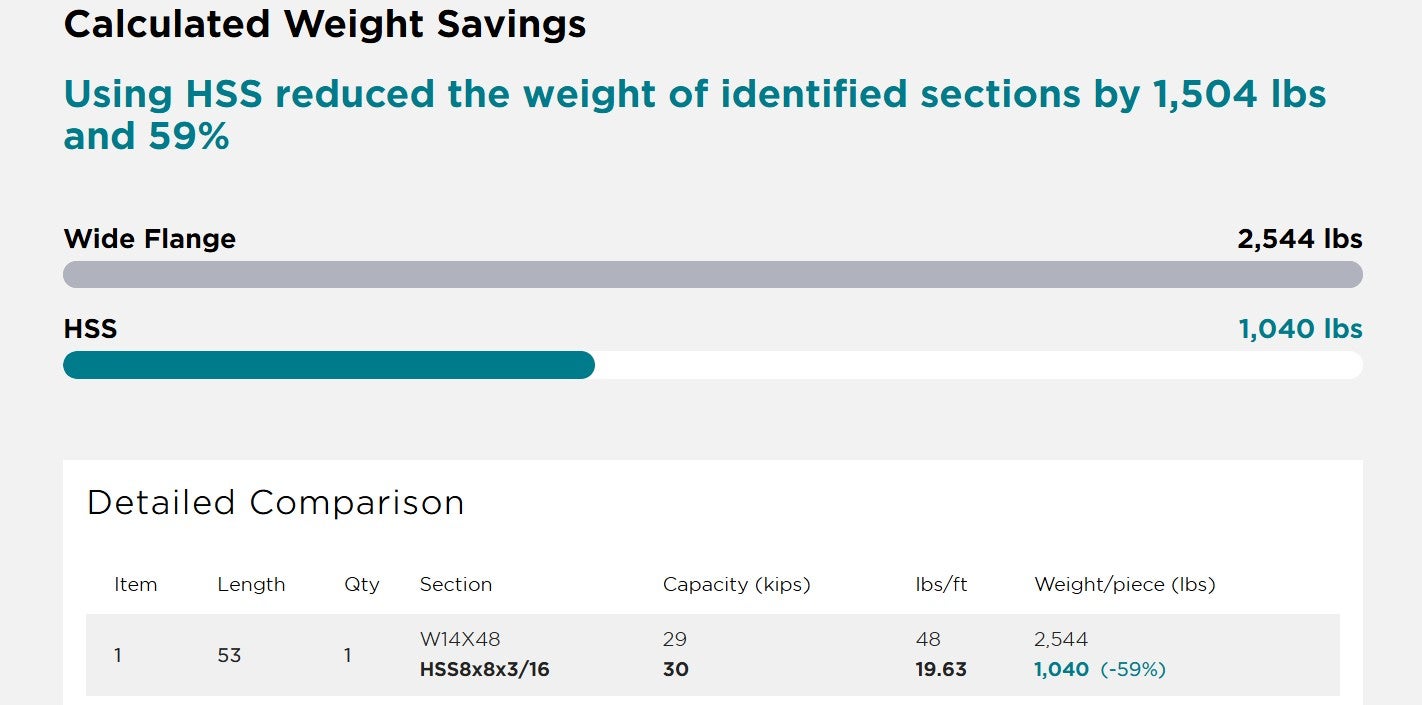
The HSS Vs. Wide Flange Comparison Tool facilitates an efficient switch to HSS by proving weight savings to project stakeholders.
When Should Engineers Use the HSS vs. Wide Flange Column Comparison Tool?
The HSS vs. Wide Flange Column Comparison Tool is most valuable in two scenarios.
During early schematic design, when the structural system is not yet fixed, the tool quickly establishes whether HSS columns can deliver a weight and cost advantage over wide flange alternatives for a given column grid and load. Use it to optimize design before detailing begins.
During value engineering, when the project is under budget pressure, the tool provides a simple, data-backed justification needed to propose a switch from wide flange to HSS. A report showing specific weight and cost savings, calculated against the actual column schedule, is more persuasive than a general claim that HSS could be lighter.
Choose HSS columns over wide flange when:
- Gravity column loads are the controlling design case
- Biaxial bending or torsion is a secondary concern
- Column aesthetics matter (exposed condition, AESS)
How Does the Axial Load Calculator for HSS Columns Work?
Rapidly evaluating column capacity is critical during schematic design and at late-stage design changes. The Axial Load Calculator enables engineers to quickly determine the axial strength of HSS columns in two modes:
- Capacity mode — enter an HSS section designation and column length; the tool returns available axial capacity in both ASD and LRFD formats
- Size mode — enter a required column length and axial demand; the tool returns the HSS sections that satisfy those parameters
Both modes operate across rectangular, round, and square HSS.
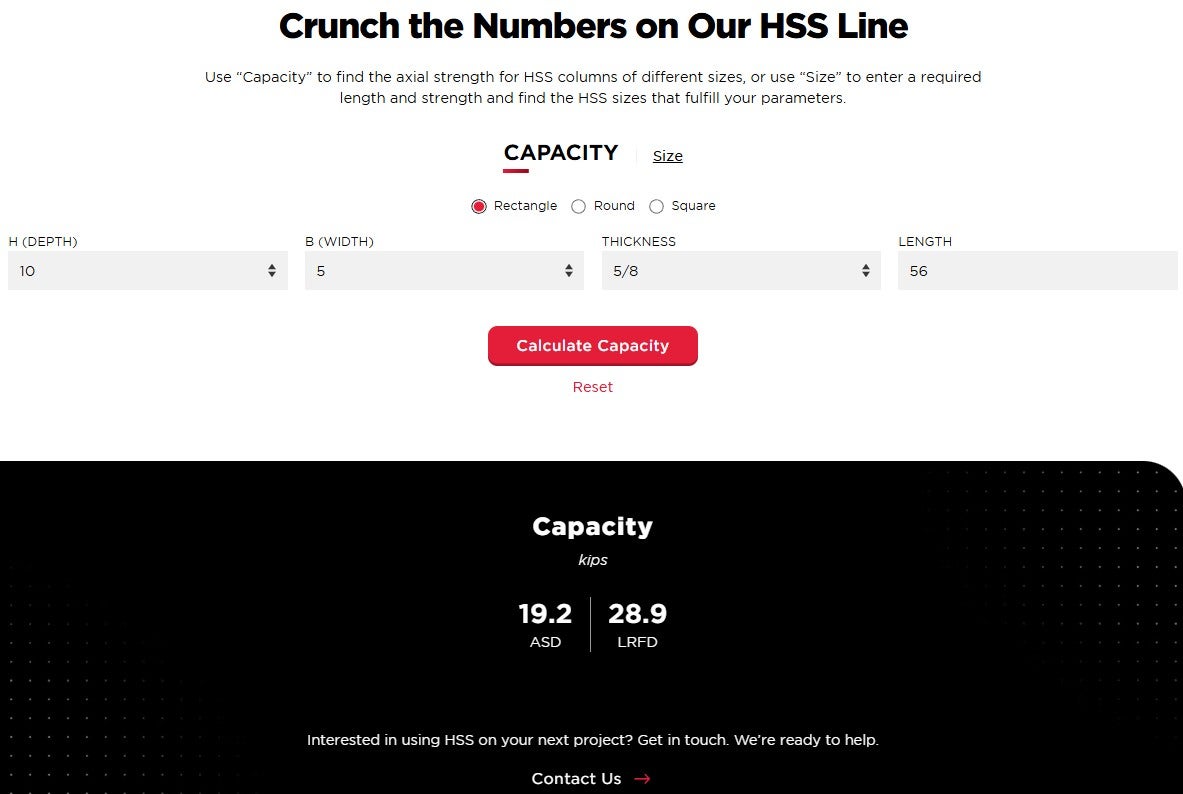
The Axial Load Calculator streamlines design time by automatically determining HSS’ axial strength.
What Are the Technical Standards Behind the Axial Load Calculator?
The Axial Load Calculator is built on a consistent technical foundation:
- Design specification: AISC 360-22 (as published in the 16th Edition of the AISC Steel Construction Manual)
- Material properties: ASTM A500-21, with Fy = 50 ksi for round, square, and rectangular sections
- Output formats: ASD and LRFD axial capacity values
Instead of manually working through column slenderness checks and effective length factors for multiple candidate sections, the Axial Load Calculator returns results across the full Atlas Tube HSS size range in seconds.
Note that the Axial Load Calculator is provided for informational and preliminary sizing purposes. Final member selection should be confirmed through project-specific engineering calculations that account for all applicable load combinations, connection conditions, and code requirements.
Start Using Atlas Tube’s HSS Engineering Tools Today
Integrating these four tools into your daily structural design workflow can reduce the time spent on repetitive manual calculations, eliminate the maintenance burden of custom spreadsheets, and produce connection designs that fabricators can build without redesign requests. Each tool targets a specific point in the HSS design process — from early column selection through final connection detailing — and all are backed by Atlas Tube’s in-house structural engineering expertise.
Links to each resource are below:
- Explore the HSS Connections Hub
- Run a column comparison
- Check axial load capacity
- Evaluate HSS beam alternatives
- Connect with Atlas Tube’s Engineering Experts for a free consultation on using HSS
Brad Fletcher, Senior Structural Engineer at Atlas Tube, holds the S.E. license—structural engineering’s most advanced credential. With 30+ years of practice, he has served as an HSS industry liaison since 2011.