
Bolted HSS Connections: A Practical Guide to Faster Field Joints

Hollow Structural Sections (HSS) deliver remarkable strength-to-weight performance, yet many engineers hesitate when they reach the connection stage. The closed geometry that makes HSS so efficient can block access to the inside of the member. That single constraint shapes nearly every decision you make about designing bolted HSS connections and bolting HSS in the field.
The good news? You have more options than ever. From standard bolts and through bolts to single-sided fasteners and the Shuriken® Structural Nut Keeper, you have methods to design bolted HSS connections with confidence. This guide walks through common connection types, the limit states that govern them, and various design resources that can keep your details code compliant.
Here’s what we’ll cover:
- Comparison of bolted connection methods for HSS
- How shear lag factors from AISC 360 affect your gusset plate design
- Where Shuriken can save labor on column and truss splices
- Acceptable connections for seismic moment frames
Bolted Connection Types for HSS
There is no single “right way” to design bolted HSS connections. The limit states resemble those of other bolted connections, so most of your existing knowledge on bolted connections transfers directly. Your challenge is to match the method to the load path and the access you have.
Standard Bolts
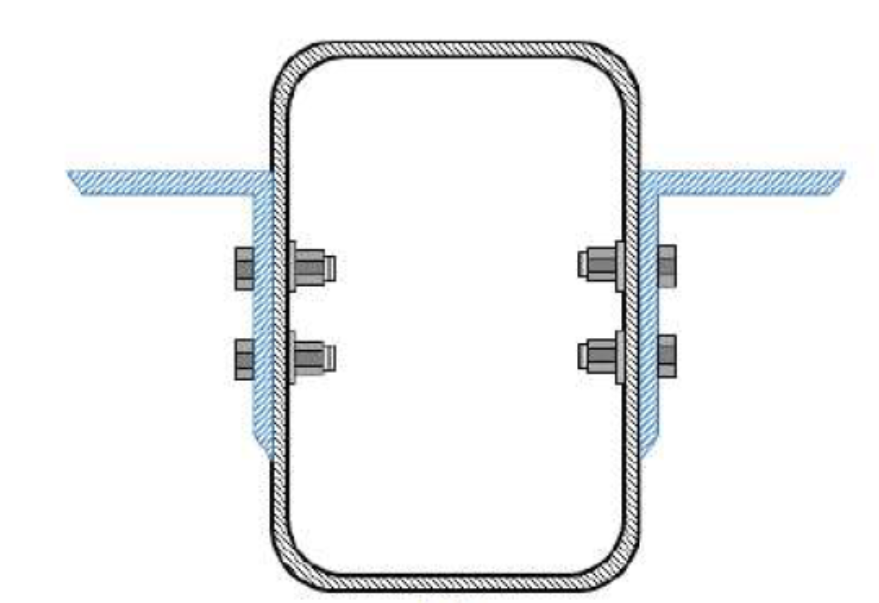
You can connect to HSS sidewalls using access holes when the section runs large enough. This approach allows for full pretensioning. Under shear, you must check bearing on the HSS wall. Under tension, additional HSS limit states come into play, including bolt pullout and face plastification.
Through Bolts
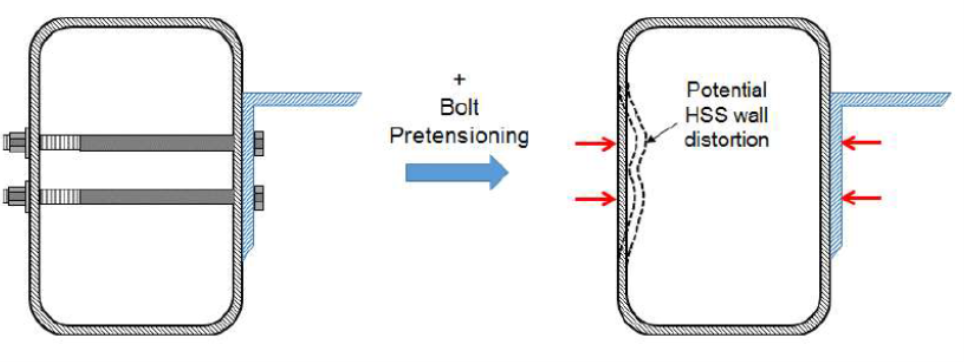
Through bolts pass completely through the member, but they cannot achieve pretension because tightening distorts the HSS wall. Even snug-tight installation as defined in RCSC cannot be achieved because the space inside HSS sections prevents all plies from reaching full contact. Due to these factors, the connection behaves more like a pin than a bolt, reducing bearing capacity. To restore the ability to pretension bolts, consider adding an internal sleeve that stiffens the wall.
The Shuriken® Structural Nut Keeper
Shuriken® changes the economics of field-bolted HSS connections. This system uses standard A325 and A490 bolts with no field welds and no proprietary one-sided fasteners. Instead, you tack weld Shuriken with nuts inside in the shop, then install bolts quickly in the field. Shuriken is available in 5/8” through 1-1/8″ sizes.
Why Engineers Choose Shuriken
- One-sided connections with higher capacity per bolt than competing solutions
- Slip-critical capability
- A clean alternative to end plates or access holes
- Installation with standard hardware and standard tools
- Compliance with RCSC and AISC
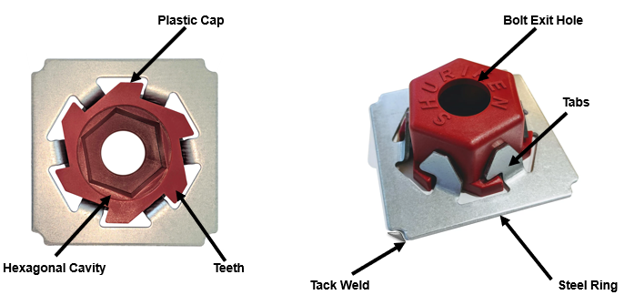
Shuriken was designed to facilitate greater efficiency during the erection process.
Applications For Shuriken
Shuriken excels across several connection types, including column splices, HSS beam and brace connections, SpeedCore, and more. It delivers faster erection, simplifies inspection, and reduces labor compared to field-welding. Shuriken maintains tolerance and adjustability by allowing the nut to move laterally to accept bolts even when holes are misaligned. Shuriken connections are more compact than endplates or knife plates and yield the clean look that architecturally exposed structural steel (AESS) demands.
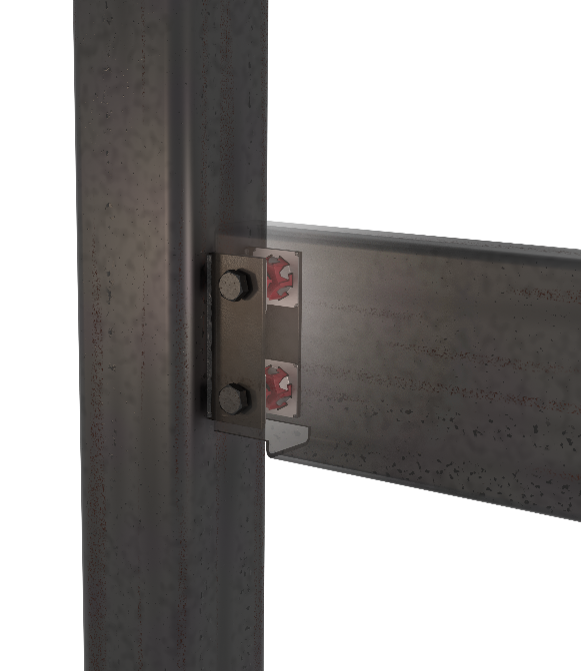
Using Shuriken with HSS beam connections can be designed to carry large loads while eliminating the need for field welding.
Single-Sided Bolts
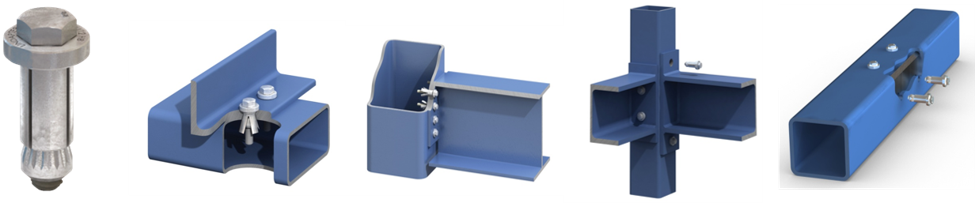
Single-sided fasteners solve the access problem outright by installing from one face through a pre-drilled hole. Single-sided fasteners are good options when loads are small, or when there is no access in the shop to install a Shuriken. Two popular products lead this category:
- Lindapter Hollo-Bolt™: The only expansion bolt with ICC-ES seismic approval for structural steel across Seismic Design Categories A through F, in compliance with IBC 2009-2018. Hollo-Bolt enables fast one-sided installation with high tensile and shear resistance.
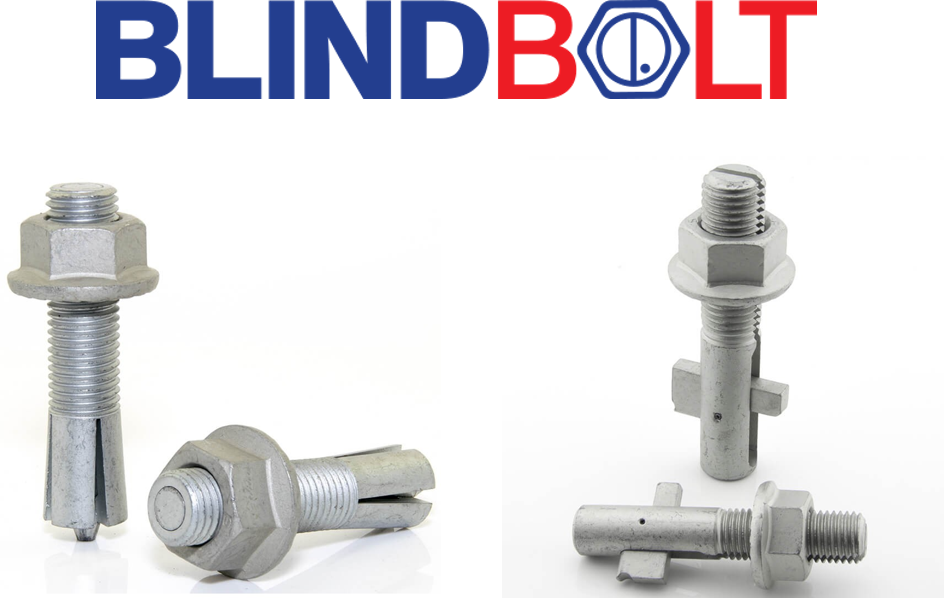
- Blindbolt Blind Bolt: A versatile fastener that pivots an internal anchor to form a strong connection from one side. Blind Bolt relies on a toggle to keep it in place within the hole.
Threaded Studs, Power Nails, and Flow Drilling
For lighter loads, threaded studs and power-driven nails can offer quick fastening. You can either weld threaded studs or mechanically fasten them.
Flow drilling presents another option; the process creates a threaded hole directly in steel between 1/4″ and 1/2″ thick. When you match the right wall thickness, flow-drilled holes develop the full tensile capacity of A325 bolts.

Studs
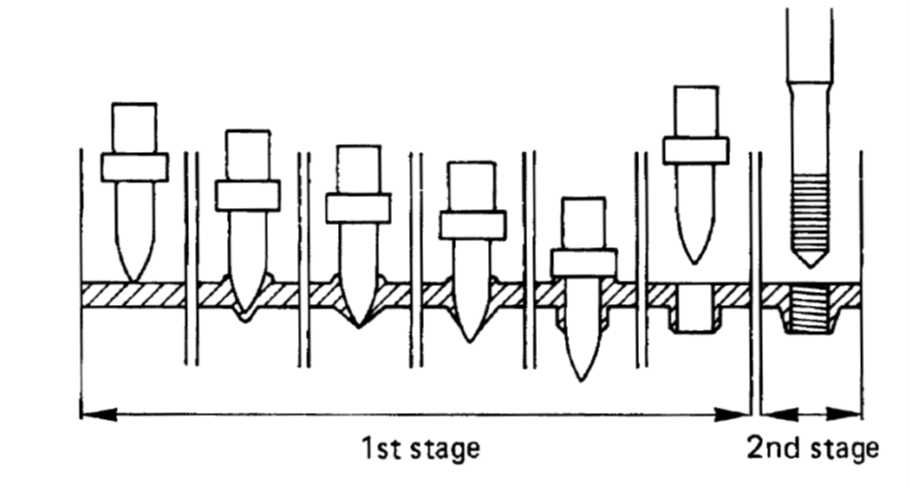
Flow drilling
Splice and Gusset Plate Connections
Since bolting directly into the walls of a hollow section can be difficult, engineers sometimes move the bolts outside the section by welding attachments to the exterior of the member.
- End Plate Splices incorporate plates welded to the end of the HSS members. The members can then be mated end-to-end and bolted through the end plates. Such connections are economical in compression, but require thicker plates to resist tension or moment. End plate splices increase the overall size of the member, so they may be problematic in cases with architectural requirements.
- Exterior Gusset Connections incorporate plates welded to the exterior walls of the HSS which extend past the edges of the members. These plates provide accessible surfaces through which bolts can be attached.
Limit States and Shear Lag Factors
Slotted HSS gusset plate connections demand a careful limit-state review. You must check HSS tensile yielding on the gross area, tensile rupture on the net section, base metal shear in both the HSS and gusset plate, weld capacity, and the usual bolt-related limit states.
Shear lag deserves particular attention. In some circumstances, it may not be possible to develop the full yield strength of a bracing member when only part of the cross section connects to the gusset. AISC 360 Table D3.1 governs the shear lag factor, U:
- Case 5 (round HSS, single concentric gusset plate): When weld length l ≥ 1.3D, U = 1.0. When D ≤ l < 1.3D, U = 1 − x̄/l, with x̄ = D/π.
- Case 6 (rectangular HSS, single concentric gusset plate): When l ≥ H, U = 1 − x̄/l, with x̄ = (B² + 2BH) / 4(B + H).
- Case 6 (rectangular HSS, two side gusset plates): When l ≥ H, U = 1 − x̄/l, with x̄ = B²/4(B + H).
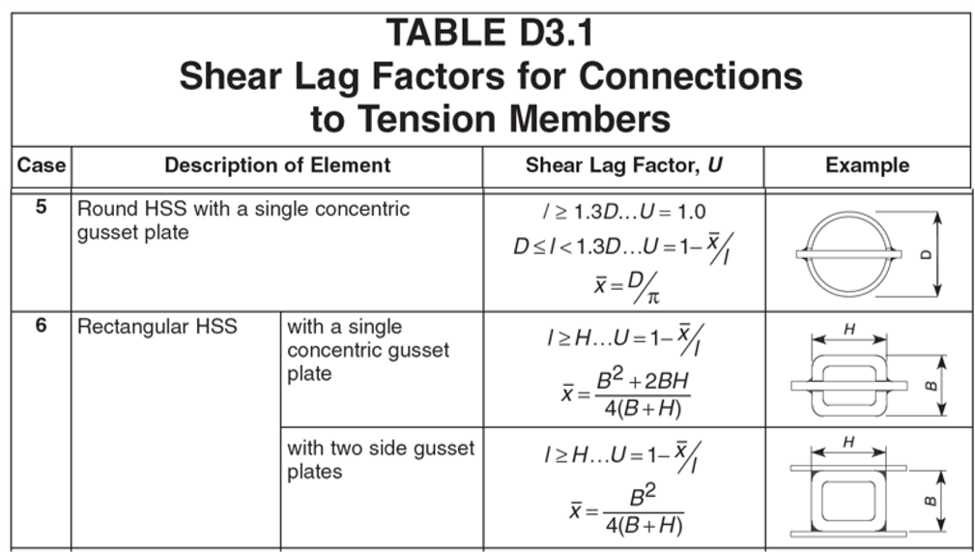
Weld length, l, should be greater than H or D, the distance between welds. This requirement is implied by the U factors in Cases 5 and 6.
Shear, Moment, and Seismic Connections
Every shear connection used between wide-flange beams and columns works for HSS columns too: single shear plates, single and double angles, stiffened and unstiffened seats, and T connections are all options, with the best option depending on the column section and magnitude of loading. The single shear plate (shear tab) is the most economical choice. Through-plate connections are the costliest and should be reserved for situations where axial load in the beams needs to be transmitted through the column.
For wide flange beam to HSS column moment connections, there are several options, with increasing strength and stiffness generally corresponding to greater fabrication cost.
The simplest approach is to weld flange plates directly to the face of the HSS column, though that approach is limited by the strength of the column face, with thicker HSS walls generally corresponding to greater moment resistance. In cases where more strength or stiffness are required, connections that transmit load more directly to the sidewalls of the column, such as wraparound or diaphragm connections are preferred.
Seismic moment connections bring additional design and detailing requirements. Connections in SMF and IMF systems must qualify under AISC 341-10, Chapter K, or earn prequalification under AISC 358-10, Chapter K. Three prequalified connections apply directly to HSS, all of which are proprietary:
- ConXtech ConXL™ – ideal to meet the demanding requirements for commercial, structures, schools, parking garages, data centers and industrial applications for the oil and gas industries.
- MiTek SidePlate® – engineered to reduce overall tonnage, minimize required connections, and accelerate erection times.
- Durafuse Frames® – helps reduce frame construction cost while improving efficiency from design through erection.
Design Resources Worth Bookmarking
Strong details start with strong references. Keep these resources close:
- AISC 360, Chapters J and K
- AISC Design Guide #24
- Atlas Tube’s complimentary
- CISC Design Guide and CIDECT Design Guides
- Steel Tube Institute tools, including HSS CONNEX Online
Key Takeaways
Bolted HSS connections no longer require compromise. Standard bolts can be pretensioned using the Shuriken Structural Nut Keeper, or through hand holes where forces on the connection are small. Single-sided fasteners are useful in cases lacking access in the shop and field, and bolted options incorporating end or gusset plates provide simple options in industrial and similar applications where compactness and aesthetics are not concerns.
Remember the fundamentals: check every limit state, respect shear lag through AISC 360 Table D3.1, and lean on prequalified connections in seismic zones. With Atlas Tube’s full domestic size range and the design resources above, you can specify HSS with confidence from concept through erection.
Ted Goldstein, Business Development Engineer at Atlas Tube and a licensed P.E., invented the patented Shuriken Structural Nut Keeper®. A former bolting inspector, he focuses on HSS connection solutions.