
What Is an Environmental Product Declaration (EPD)?
An Environmental Product Declaration (EPD) is a standardized, third-party verified document that quantifies a product’s environmental impact across its entire life cycle, giving engineers crucial product data. For structural engineers and LEED project teams, facility-specific EPDs replace conservative industry averages with exact Global Warming Potential (GWP) figures tied to the actual production source, enabling precise embodied carbon calculations and defensible material selection.
An Environmental Product Declaration (EPD) is a standardized, third-party verified document that quantifies a product’s environmental impact across its entire life cycle. Governed by ISO 14025 and grounded in a Life Cycle Assessment (LCA), an EPD provides verified, comparable numbers that architects, engineers, and procurement teams use to choose sustainable building materials.
Why Environmental Transparency Has Become a Competitive Requirement
Clients who once accepted a manufacturer’s word on sustainability now expect verified data. That shift is real, measurable, and accelerating. California’s Buy Clean Act has required EPDs for structural steel, rebar, glass, and mineral wool on state-funded projects since 2021. Colorado and New York have also passed comparable statutes. At a larger level, the EU’s revised Construction Products Regulation became applicable in January 2026, embedding life-cycle environmental data directly into compliance requirements for products sold across the European market.
Green building certifications have moved in the same direction. LEED v5, which launched in March 2026, made EPD-backed embodied carbon data a prerequisite rather than a bonus credit. BREEAM ties EPDs to its Mat 01 credit, which measures whole-building life-cycle impacts. Ultimately, a product without an EPD is increasingly a product at a competitive disadvantage — not because it performs worse, but because its performance cannot be proven.
For senior structural engineers managing complex projects and compressed timelines, that gap between “we think our material is sustainable” and “here is the verified number” is where specifications are won or lost.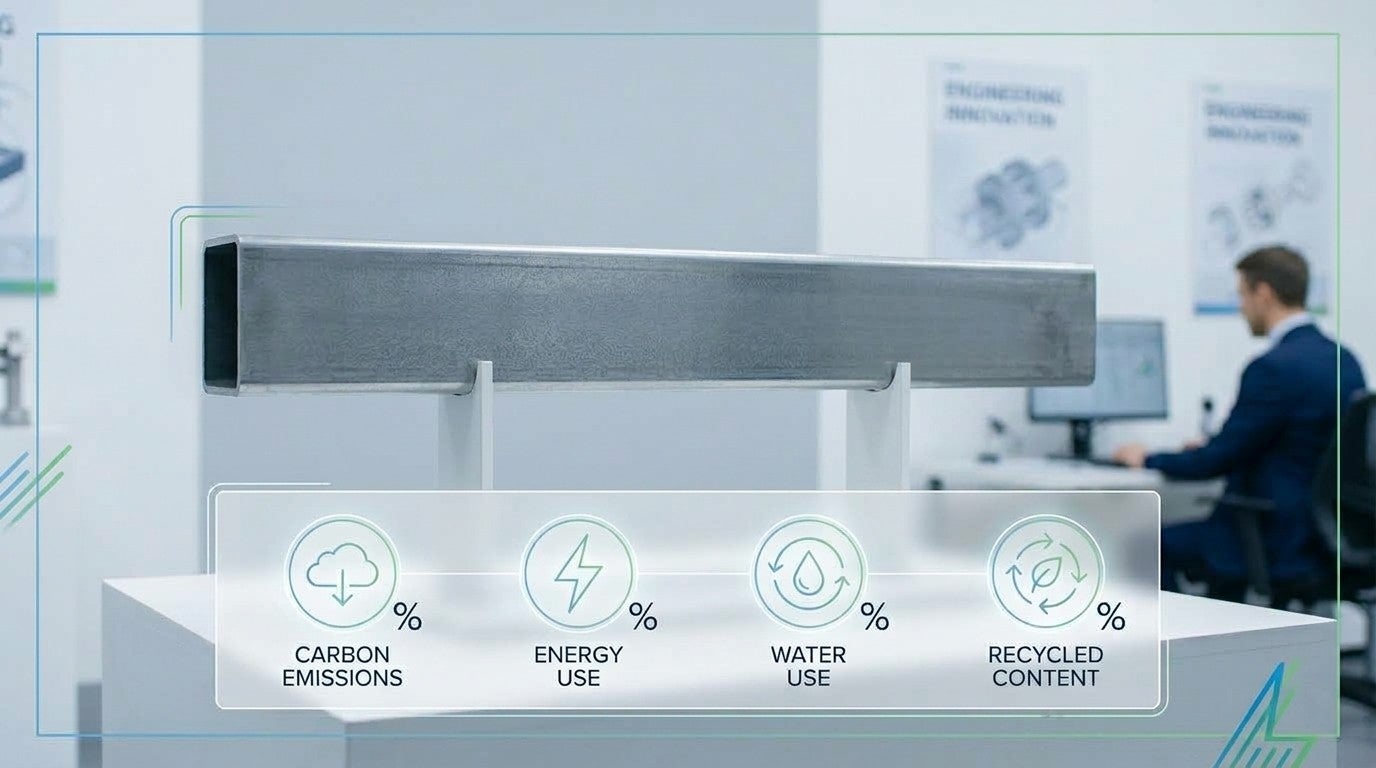
New Buy Clean legislation has made the environmental impact of products paramount when selecting building materials.
What Is an EPD?
An EPD is a Type III environmental declaration under ISO 14025 — one of three types of environmental product labels recognized by the International Organization for Standardization. The distinction between types is important.
- Type I labels (ISO 14024) are ecolabels, such as Energy Star or the Nordic Swan. They certify that a product meets a defined environmental threshold — essentially a pass/fail.
- Type II labels (ISO 14021) are self-declared environmental claims, such as “made from recycled content.” These are not independently verified.
- Type III declarations, or EPDS, are different from both. They report verified, quantified environmental impact data across multiple categories without making a judgment on whether those numbers are “good” or “bad.” The EPD gives you the data. You draw the conclusion.
An EPD is the product of a full life-cycle assessment, independently reviewed against published Product Category Rules (PCRs), verified with a Program Operator, and valid for five years from publication date.
What Information Does an EPD Contain?
The public portion of an EPD presents environmental impact data in a standardized, tabular format. That data is drawn from an LCA that tracks the product from raw material extraction through manufacturing, transportation, use, and eventual end-of-life handling. Practitioners call this tracking “cradle to grave,” though some EPDs cover only “cradle to gate” (through manufacturing).
The impact categories most reported include:
- Global Warming Potential (GWP) — the product’s contribution to greenhouse gas emissions, expressed in kilograms of CO₂ equivalent (kg CO₂e). This is the figure most relevant to embodied carbon calculations in building design.
- Ozone Depletion Potential (ODP) — impact on stratospheric ozone, expressed in kg CFC-11 equivalent.
- Acidification Potential — contribution to acid rain, expressed in kg SO₂ equivalent.
- Eutrophication Potential — nutrient runoff into water bodies, expressed in kg phosphate equivalent.
- Smog Formation Potential — contribution to ground-level ozone, expressed in kg O₃ equivalent.
- Primary Energy Demand — total energy consumed across the life cycle, split between renewable and non-renewable sources.
For structural engineers running a life-cycle assessment on a building frame, GWP is typically the most consequential figure: it is the number that supports LEED calculations, embodied carbon comparisons, and owner sustainability targets. Having a product-specific GWP number rather than a conservative industry average lets you calculate with precision and defend your material selection to stakeholders.
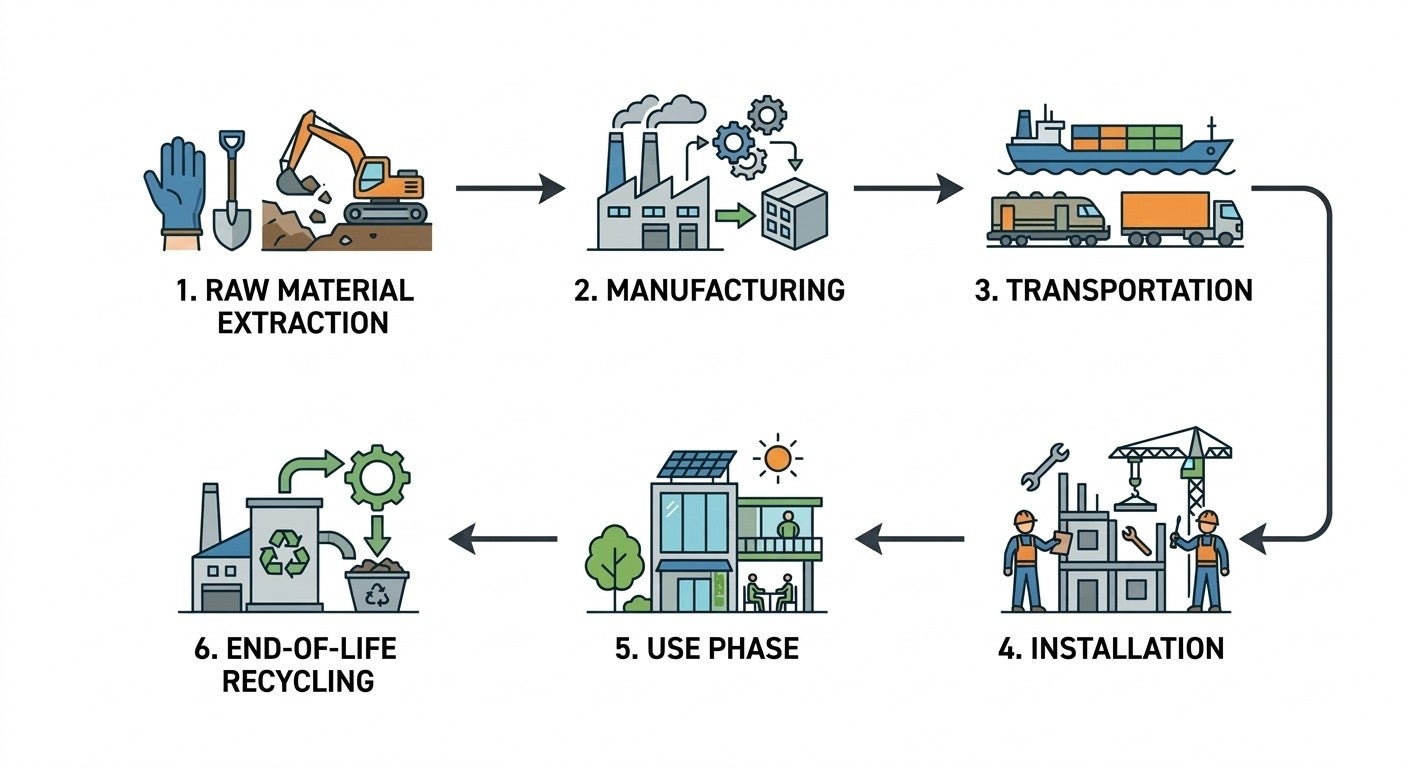
EPDs rely on LCA’s that track a product from “cradle to grave.”
The Standards That Govern EPDs: ISO 14025, EN 15804, and ISO 21930
Three layers of standards define how an EPD is built and what it must contain. ISO 14025 establishes the global framework for Type III EPDs. It defines what an EPD is, sets requirements for Program Operators, and connects EPD development to the LCA methodology in ISO 14040 and ISO 14044.
EN 15804 adds construction-sector specificity for European markets. Where ISO 14025 is the operating system, EN 15804 is the construction application on top of it. It organizes the product life cycle into defined modules — A1 through A3 for manufacturing, C1 through C4 for end of life, and module D for potential reuse — so that EPDs for two competing products can be compared on the same basis.
ISO 21930 serves a parallel function in other international markets, providing core rules for the sustainability of construction products and requiring consistency in how EPDs report environmental data.
Product Category Rules (PCRs) provide the third layer and are essential to comparability. A PCR defines the specific data collection methods, system boundaries, allocation rules, and impact categories applicable to a given product type. Without a PCR, two manufacturers could produce EPDs for structurally identical products using different methodologies, making meaningful comparison impossible. Program Operators typically oversee, publish, or maintain PCR development processes.
Who Creates EPDs and What Is a Program Operator?
A manufacturer does not produce an EPD by themselves. The process involves three distinct parties working in sequence.
First, the manufacturer or industry association commissions a Life Cycle Assessment from a qualified LCA practitioner. The LCA collects primary and secondary data across the product’s full supply chain and calculates impact across all required categories.
Second, an independent verifier approved by the Program Operator reviews the LCA and EPD document against the applicable PCR and ISO standards. This step is not optional. ISO 14025 mandates third-party verification before a declaration can be registered and published.
Third, the Program Operator registers, hosts, and maintains the EPD in a publicly accessible database. Program Operators in North America include NSF International, UL Solutions, SCS Global Services, and ASTM International. In Europe, the International EPD System (EPD International) is the largest operator by registered declarations. Manufacturers in the construction sector often work with operators whose databases are recognized by LEED and BREEAM.
The Program Operator ensures that every EPD it publishes meets the same minimum standards — which is what makes declarations from different manufacturers comparable in the first place.
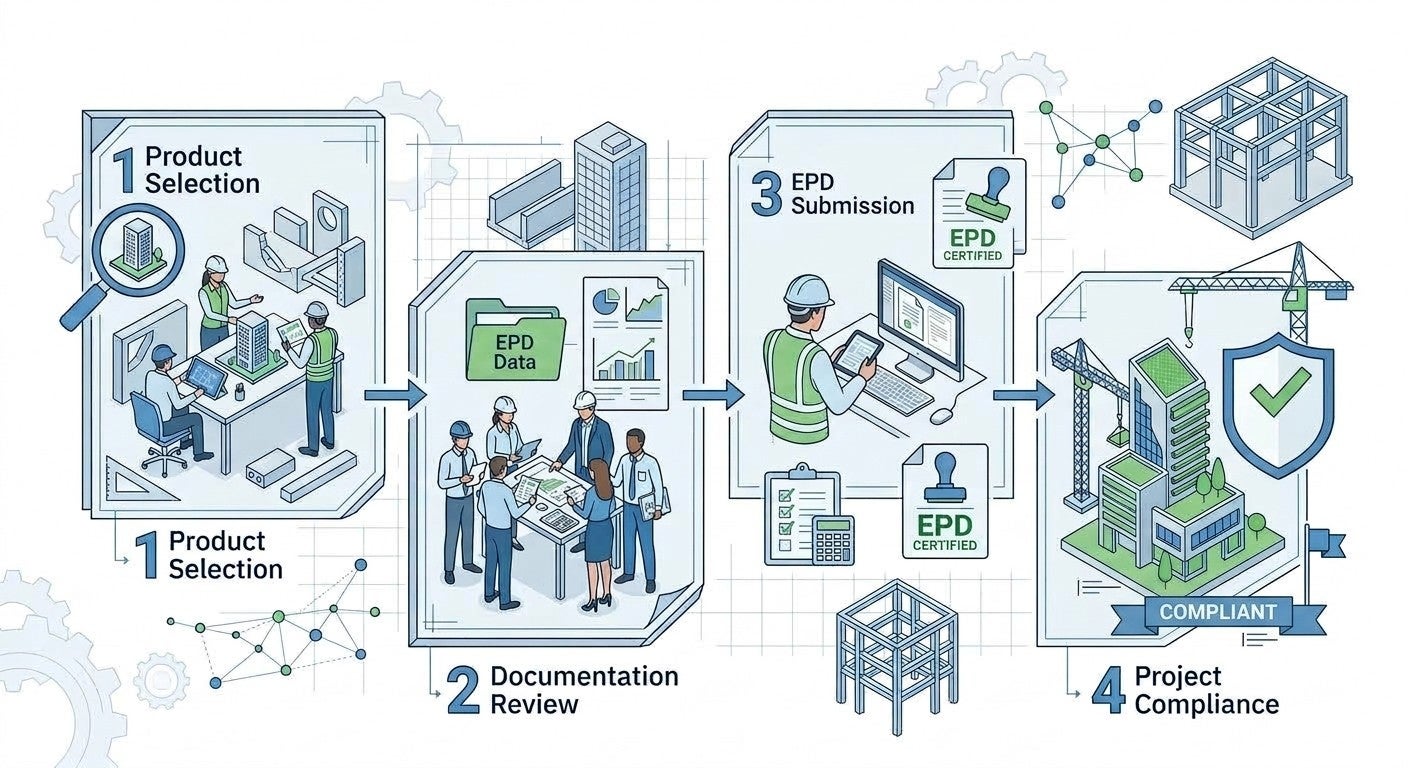
All EPDs go through a thorough review and publication process to become verified.
Industry-Wide vs. Product-Specific EPDs
Not all EPDs carry equal weight in project documentation or green building credit calculations. Understanding the distinction between the two main types matters when you are writing specifications or assembling a LEED submittal.
Industry-wide (generic) EPDs represent the average environmental performance across participating manufacturers of a product type. They are developed by industry associations and verified by a third party. Industry-wide EPDs are useful as a baseline. Under LEED v4.1, an industry-wide EPD counts as one full product toward the 20-product threshold for the first Materials and Resources credit point — the same as a standard product-specific EPD. More critically, the “average” number used may be higher than the actual performance of the specific manufacturer you are specifying, which can misrepresent the true embodied carbon of your project.
Product-specific EPDs are published by a single manufacturer for a specific product or product line. In some cases, they are published for a specific factory. Under LEED v4.1, industry-wide EPDs count as one product, while product-specific EPDs have more value when they include external review. Where product-specific EPDs pull ahead is at the top tier: a product-specific EPD with an external critical review counts as 1.5 products, giving project teams a more efficient path to credit achievement. More practically, a facility-level EPD gives design teams a defensible number that reflects actual production conditions rather than a statistical average across an entire industry.
Atlas Tube is one concrete example of what facility-level coverage looks like in practice. Atlas Tube publishes facility-specific EPDs for every one of its HSS manufacturing locations across the US and Canada, covering Chicago, IL; Kansas City, MO; Birmingham, AL; Blytheville, AR; Harrow, ON; and Plymouth, MI. Several of those facilities also carry separate Electric Arc Furnace (EAF)-only EPDs: Chicago, Kansas City, and Harrow each have EAF-specific declarations. For teams specifying Jumbo™ HSS, Atlas Tube publishes a dedicated Blytheville Jumbo™ EPD covering those sections specifically.
The difference matters most in high-precision contexts: comparing domestic versus imported steel, running a whole-building LCA to meet a client’s carbon target, or providing documentation to a sustainability consultant. Ultimately, facility-specific EPDs can increase precision when choosing materials for a project.
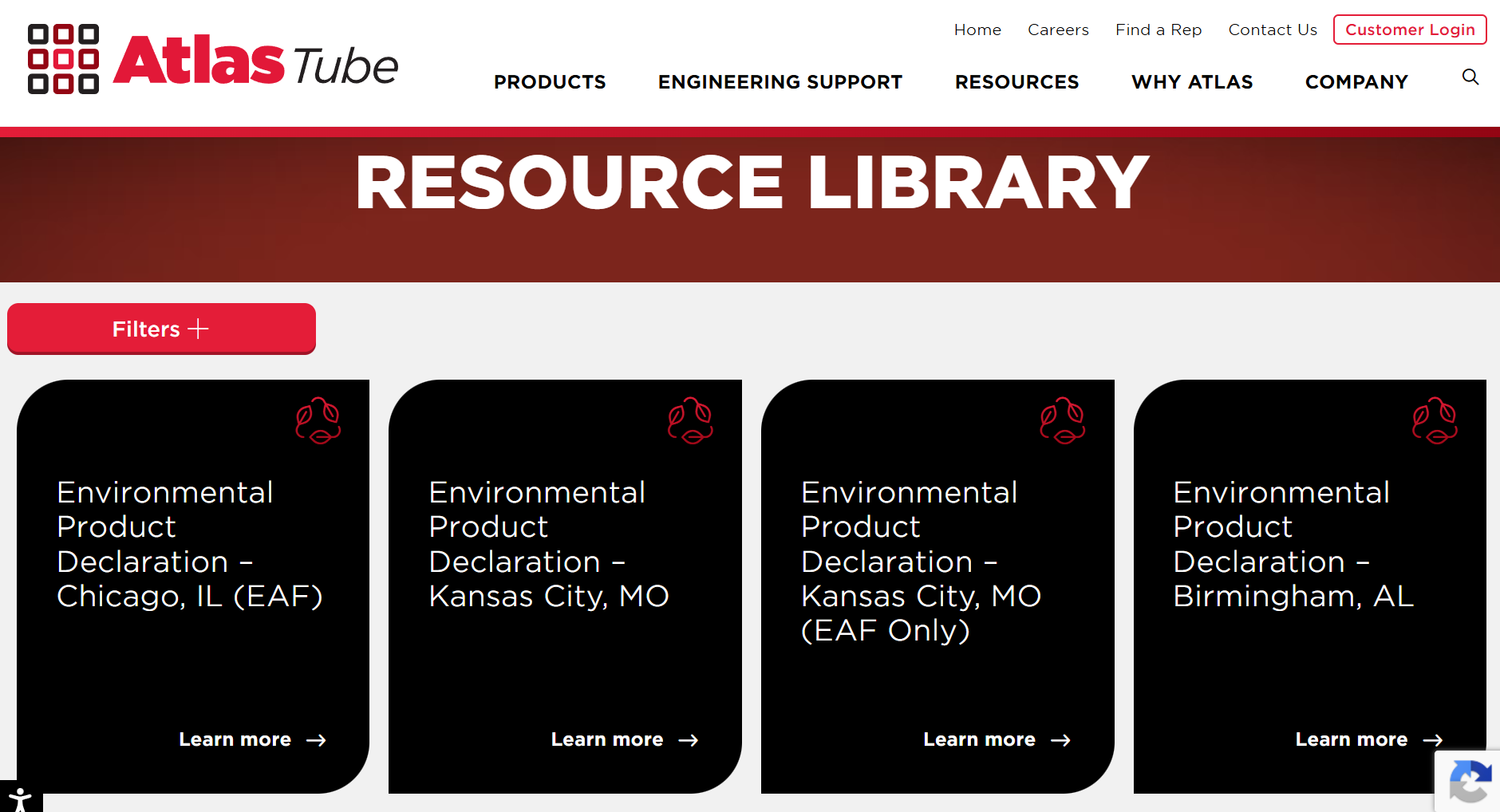
Atlas Tube has facility-specific EPDs for all of its locations.
Who Uses EPDs and Why?
EPDs are used by three major project team groups.
Architects and structural engineers use EPD data to compare materials during design, run life-cycle assessments on whole buildings, and justify material selection to owners who have sustainability requirements. For a senior engineer evaluating whether to specify domestic hollow structural sections (HSS) versus imported alternatives, a factory-specific EPD provides the GWP figures needed to make that comparison credible.
Procurement teams and owners use EPDs to meet obligations imposed by green building standards, government contract requirements, or internal sustainability commitments. In jurisdictions covered by Buy Clean legislation, EPDs for specified materials are often a compliance requirement.
Green building certification reviewers use submitted EPDs to determine compliance for credits within categories related to materials. In LEED v4.1, up to two points are available through the Building Product Disclosure and Optimization: EPDs credit. Broadly speaking, one point requires 20 qualifying products with EPDs; earning a second point requires those products to demonstrate improved environmental performance versus baseline values. LEED v5 requires quantifying and assessing embodied carbon, and EPDs are a key source of GWP data. This means that the question is no longer whether to provide them, but whether yours is specific enough to be useful.
The Business and Sustainability Case for Having an EPD
For manufacturers, publishing an EPD is a transparency investment with concrete commercial returns.
Specification access. Architects and engineers writing specifications for LEED projects actively seek products with verified EPDs. A product without one may be disqualified early, especially on projects with LEED or Buy Clean requirements.
Embodied carbon differentiation. If your manufacturing process produces steel with measurably lower GWP than industry averages, an industry-wide EPD obscures that advantage. A product-specific EPD makes the gap visible and documentable. When a design team is choosing between two HSS suppliers and one has a factory-specific GWP lower than the other, the lower number can create a meaningful advantage if other products are otherwise comparable. When a manufacturer has EPDs for every facility — as Atlas Tube does — engineers never face a data gap regardless of which plant fulfills the order. The verified number is always available.
Defense against conservative assumptions. In life-cycle assessments where a product lacks its own EPD, practitioners typically fall back on industry averages or conservative proxies. Those assumptions can inflate the calculated embodied carbon of a building, which may hurt a project’s overall LCA score. A product-specific EPD can replace generic assumptions with verifiable product data.
Greenwashing protection. Vague sustainability claims are under regulatory pressure on both sides of the Atlantic. An EPD can provide a documented, third-party verified foundation for many environmental claims a manufacturer makes.
Market access. As EU CPR requirements phase in and Buy Clean legislation expands across North America, verified environmental data is moving from a voluntary differentiator towards an expectation for market access. Manufacturers who have invested in the process early will not need to scramble when a new specification calls for verified environmental data on a short timeline.
Frequently Asked Questions
What is the difference between an EPD and an LCA?
A Life Cycle Assessment (LCA) is the underlying data collection and impact calculation process. An EPD is the published, verified document that presents the results of that LCA in a standardized format. You cannot produce a credible EPD without a rigorous LCA, but an LCA by itself is not the same as a registered, third-party verified EPD.
How long is an EPD valid?
A registered EPD is typically valid for five years from its publication date, provided that key parameters like raw materials, energy sources, and manufacturing processes remain materially unchanged. Significant changes to any of those factors require the EPD to be updated and re-verified.
Does a product-specific EPD mean a product is environmentally superior?
No. An EPD reports verified impact data; it does not rate whether that data is “good” or “bad.” A product-specific EPD simply means the reported numbers reflect that product’s actual production conditions rather than an industry average. Whether those numbers are better or worse than alternatives is a judgment the user makes — which is exactly why the data needs to be specific enough to make that comparison meaningful.
How does the type of EPD affect LEED credit eligibility?
Under LEED v4.1, industry-wide EPDs count as one product toward the disclosure threshold, while certain product-specific EPDs can receive additional value. A product-specific EPD that includes external critical review counts as 1.5 products, giving project teams a more efficient route to credit achievement. Because LEED v4.1 treatment of product-specific EPDs depends on the form of review and documentation, teams should confirm that a given EPD meets the current credit language before relying on it for submittals.
Start With Data You Can Trust
Sustainability in modern construction has moved from aspiration to obligation. The projects being designed today will be measured against embodied carbon targets, green building standards, and procurement requirements that did not exist a decade ago. An EPD converts a manufacturer’s environmental performance into data an engineer can use and a certification a reviewer can accept.
For structural engineers specifying HSS, access to factory-specific EPDs rather than industry averages means calculating GWP with precision, justifying material selection with documentation, and moving through the approval process without delays from sustainability consultants asking for data you cannot provide.
Atlas Tube publishes EPDs for all its HSS facilities across the US and Canada, making it one of the few North American HSS producers with this level of facility-by-facility coverage. Download the EPDs from the Atlas Tube resource library and explore connection design resources through the HSS Connections Hub™.