
10 Reasons to Choose HSS for Your Next Project
At a Glance: HSS delivers a higher strength-to-weight ratio in compression than wide-flange sections, reduces fireproofing and coating surface area by up to 50%, and offers a smaller column footprint — giving floor space back to the owner. With 1,160 AISC-listed sizes, Jumbo HSS™ from Atlas Tube, and purpose-built connection tools like the HSS Connections Hub™ and Shuriken® Structural Nut Keeper, specifying HSS is more practical than ever across a wide range of structural applications.
Selecting the right structural materials directly impacts your project timeline, budget, and overall design efficiency. As a structural engineer, you skillfully balance the demand for high load capacities with the need to manage costs and meet architectural expectations. Traditional wide flange sections have their place, but Hollow Structural Sections (HSS) offer unique advantages that solve many common design and constructability challenges.
Whether you are detailing Architecturally Exposed Structural Steel (AESS) in a stadium or engineering a data center capable of handling heavy dynamic loads, HSS can provide streamlined solutions for various applications. Here are 10 reasons to specify HSS for your next structure.
1. Higher Strength-to-Weight Ratio
Weight drives cost in steel construction. Because HSS have strong axes, they deliver a higher strength-to-weight ratio in compression compared to equivalent wide-flange sections.
When you use HSS for columns with long, unbraced lengths, you can use less steel to carry the same axial load. Reducing the total tonnage of your steel package provides direct cost savings to the owner. Additionally, less steel means lower embodied carbon for the project, helping you meet modern sustainability targets without sacrificing structural integrity.
2. High Visual Appeal
Architects and owners frequently request exposed structural elements to create a modern aesthetic. HSS delivers clean lines and smooth surfaces that make it desirable for exposed applications. Unlike open sections that feature visible webs, flanges, and stiffener plates, HSS offers a sleek and simple profile.
The seamless look of round, square, or rectangular HSS integrates well into facades, atriums, and canopies. By choosing HSS, you can support the architect’s aesthetic vision without compromising on structural performance.

The high strength-to-weight ratio and uniform profile of HSS helped make these airport terminal canopies possible.
3. Ideal for Resiliency and Accidental Loading
Designing for unpredictable forces is a critical component of modern structural engineering. The symmetry of HSS makes it uniquely suited for applications subject to accidental impacts or blast loads in which the direction of the load is unknown.
Because HSS possesses uniform geometry, it behaves predictably regardless of load orientation. To further harden a structure against extreme events, engineers can fill HSS columns with concrete to create composite members. This approach increases load capacity and adds resilience to critical infrastructure projects.
4. Reliable Nationwide Availability
Supply chain delays can quickly derail a project timeline. Fortunately, HSS is stocked and readily available across North America. Domestic producers like Atlas Tube ensure that engineers and fabricators have reliable access to the materials they specify.
For large-scale projects that require significant amounts of material on a consistent basis such as data centers, project owners should work with their distributors and fabricators to secure an order with an HSS producer to ensure availability and customize lengths. Rolling tubes to project-specific lengths minimizes scrap metal, reduces field cutting, and helps project teams build more efficiently. This helps maintain project schedules and optimize material costs.
5. Reduced Coating and Fireproofing Requirements
Surface area directly drives the cost and labor required for painting and fireproofing. Compared to wide-flange sections of equal structural capacity, HSS has a smaller perimeter and surface area. This reduced surface area (up to 50% less) means you need less material for intumescent coatings or protective paints on HSS’ exterior, lowering project costs.
HSS also lacks reentrant corners. When you apply coatings to open sections, material tends to pool in corners or thin out on sharp flange edges. The smooth, continuous surface of HSS allows for a highly consistent coating thickness, simplifying application and ensuring better long-term durability.
6. Smaller Footprint for Usable Floor Space
Clients continually push for more usable square footage within their buildings. Due to its highly efficient shape, HSS columns require a smaller footprint than wide flange shapes of equal axial loading capacity.
By specifying HSS for your column applications, you give valuable floor space back to the client. This spatial efficiency is particularly beneficial in multistory commercial buildings, warehouses, and parking structures. It allows for more open, clean designs and helps you easily navigate stakeholder demands for maximum functional space.
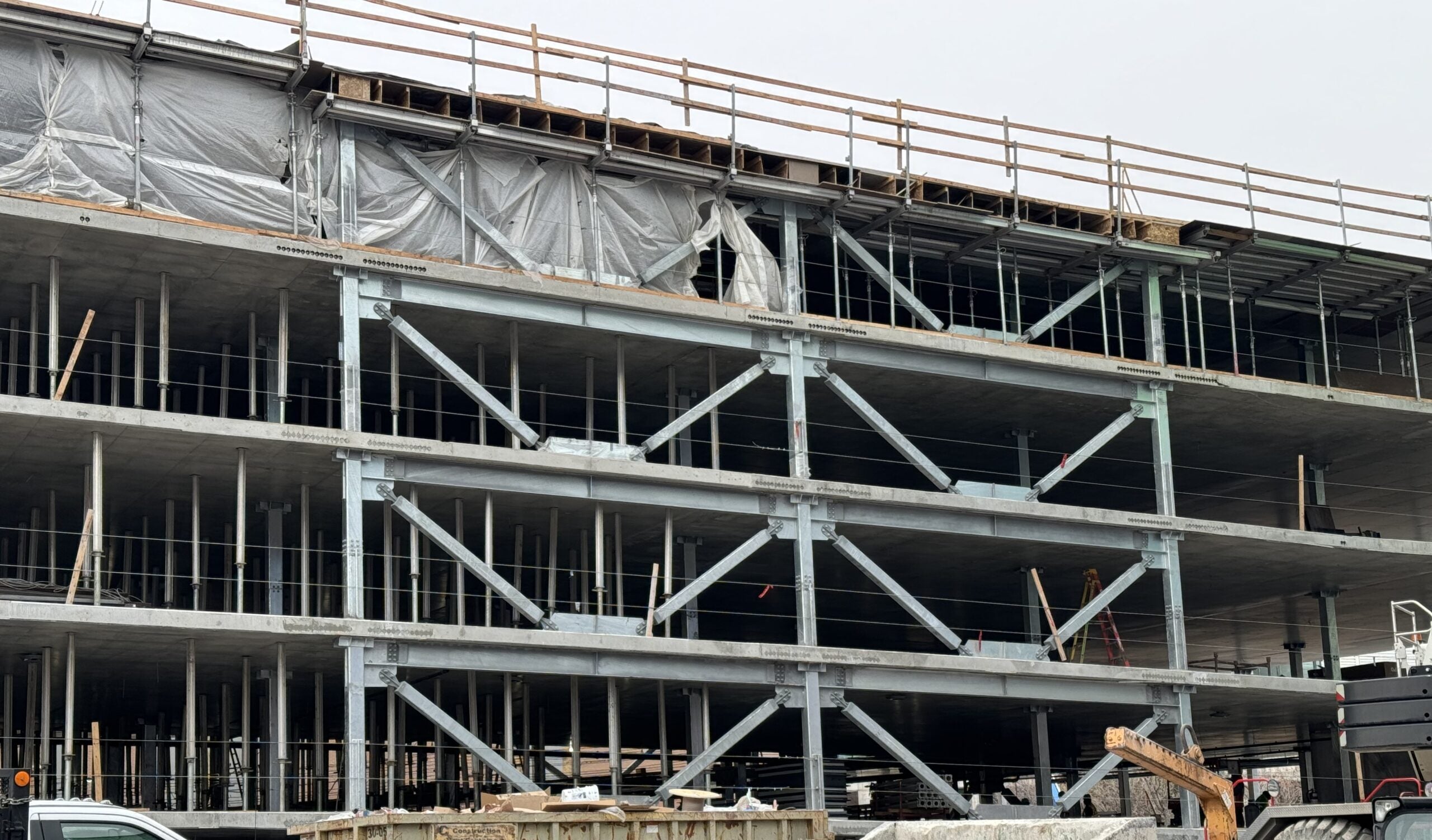
The buckling-restrained brace frames using HSS keep sight lines in this parking garage clear, enhancing driver and pedestrian safety.
7. High Efficiency in Resisting Combined Loading
Dealing with biaxial bending requires strategic material selection. Because the closed shape of HSS distributes material evenly around the perimeter of the section, it is efficient at resisting combined loading.
This perimeter material distribution gives HSS excellent torsional resistance. When engineering long-span applications or unbraced columns, HSS outperforms open sections by significantly reducing the risk of lateral torsional buckling. You can achieve longer spans with fewer intermediate supports, streamlining the overall framing plan.
8. No Webs to Manage or Maintain
The geometric simplicity of HSS extends beyond initial visual appeal. Open sections feature webs that accumulate dust, debris, and moisture, which can lead to corrosion over time, especially in industrial or outdoor environments.
Since HSS is a closed section, there are no webs or interior corners to manage. This simplifies routine maintenance and cleaning for the building owner. For food processing facilities, manufacturing plants, or clean rooms, the absence of webs makes HSS the superior choice for maintaining a sanitary, easily cleanable environment.
9. Wide Range of Sizes and Shapes
Material limitations should never dictate your design. Today, structural engineers have access to a massive variety of HSS profiles. The 16th Edition of the AISC Steel Construction Manual lists 1,160 different HSS sizes.
Atlas Tube has the largest size range of any HSS producer in North America and is the only domestic manufacturer that manufactures Jumbo HSS™. You can specify square sections ranging from 0.5″ to 22″, rectangles from 1.5″x1″ up to 34″x10″ with 1” wall thickness, and rounds from 0.84″ up to 28″ in outside diameter. By working with Atlas Tube, you can quickly procure even the largest sizes of HSS needed to support extreme loads and ambitious structural designs.
10. Streamlined Connection Design and Fabrication
A common objection to using HSS is the perceived complexity of connection design. However, modern tools and hardware have solved this challenge. Complimentary design platforms like the Atlas Tube HSS Connections Hub™ allow engineers to quickly create and optimize fabricator-friendly HSS connections, eliminating the need for cumbersome, highly customized spreadsheets.
Additionally, connection innovations like the Shuriken® Structural Nut Keeper allow for simple, one-sided bolted connections in the field. This eliminates the need for expensive and time-consuming field welding. By utilizing these advanced resources in tandem, you can design clean, efficient connections that keep projects moving quickly from the shop to the job site.

Shuriken helped this pedestrian bridge’s project team cut fabrication time, reduce costs, and achieve cleaner connection profiles.
Other HSS connection technologies from Cast Connex and MiTek offer proven solutions for HSS projects as well. Cast Connex’s engineered cast steel connectors deliver precise, repeatable fabrication, while MiTek’s SidePlate® connection systems allow for more lateral frame configuration. Both options streamline field assembly and facilitate reliable structural performance, making them valuable additions to modern HSS connection design.
Optimize Your Next Design
Hollow Structural Sections offer an efficient, functional, and aesthetically pleasing alternative to traditional structural framing. By leveraging HSS’ high strength-to-weight ratio, smaller footprint, and vast array of domestically available sizes, you can deliver cost-effective projects that satisfy both architects and owners.
If you have more questions about HSS or HSS connections, visit our Frequently Asked Questions page or contact our Engineering Experts team.
Frequently Asked Questions
How Does HSS Compare to Wide Flange Sections for Column Efficiency?
HSS produces nearly equal radii of gyration about both axes, which reduces governing slenderness in biaxial column conditions and allows a lighter section to carry the same axial load as a wide-flange shape. For long, unbraced column heights — common in data centers, warehouses, and multistory frames — this efficiency advantage compounds across the entire steel package.
What Makes HSS the Preferred Choice for Architecturally Exposed Structural Steel (AESS)?
HSS eliminates the exposed webs, flange tips, and reentrant corners that complicate surface preparation and coating inspection on open sections. Its smooth, continuous perimeter satisfies the baseline geometry requirements across all AESS categories defined in the AISC Code of Standard Practice without profile modification.
How Does HSS Perform Under Seismic, Blast, or Accidental Loading Conditions?
HSS responds predictably regardless of load direction because its symmetric cross-section provides nearly equal resistance on all lateral axes — a critical advantage when the direction of an impact or blast is unknown. Filling HSS columns with concrete to create composite members per AISC 360 Chapter I further increases axial capacity and ductility for critical infrastructure applications.
What Are the Fireproofing and Coating Cost Advantages of HSS Over Open Sections?
HSS has a smaller exterior perimeter than a wide-flange section of equivalent structural capacity, reducing paintable and fireproofable surface area by as much as 50%. The smooth, continuous outer surface also eliminates the reentrant corners where coating pools or thins on open sections, producing more uniform dry-film thickness and better long-term durability.
How Large Can HSS Sections Get, and What Sizes Does Atlas Tube Produce?
The 16th Edition AISC Steel Construction Manual lists 1,160 HSS sizes across square, rectangular, and round profiles. Atlas Tube is the largest HSS producer in North America and the only domestic manufacturer of Jumbo HSS™, with square sections up to 22″, rectangles up to 34″×10″ with 1″ wall, and rounds up to 28″ outside diameter.
What Connection Systems Are Available for HSS Members to Simplify Fabrication?
The Atlas Tube HSS Connections Hub™ generates optimized, fabricator-ready HSS connections without custom spreadsheets, and the Shuriken® Structural Nut Keeper enables single-sided bolted field connections on closed sections — eliminating field welding. Cast Connex and MiTek SidePlate® round out the available options for complex nodes and HSS moment-frame configurations.
Brad Fletcher, Senior Structural Engineer at Atlas Tube, holds the S.E. license—structural engineering’s most advanced credential. With 30+ years of practice, he has served as an HSS industry liaison since 2011.